
 Home
Home Gezfeel
 Oct 27 2025
In the world of wrist accessories where fashion meets quality, moissanite watches have emerged as a top choice for countless consumers, thanks to their diamond-like brilliance, exceptional hardness, and outstanding value for money. However, many people overlook a crucial factor that determines a moissanite watch's sparkle: the inlay technique. As a professional moissanite watch manufacturer with over a decade of R&D and production experience, we're here to demystify the core inlay techniques that bring moissanite watches to life.
Why Do Moissanite Watches Demand Higher Standards for Inlay Techniques?
Before diving into specific techniques, it's essential to understand why moissanite watches require such precise inlay craftsmanship. Moissanite boasts a hardness of 9.25 on the Mohs scale—second only to natural diamonds (10)—and an even higher dispersion rate (0.104 vs. diamond's 0.044), producing more vibrant rainbow flashes. But these unique properties also set stricter requirements for inlay work: the technique must securely fasten the moissanite to prevent loss during daily wear while maximizing its brilliance without blocking light.
Below, we break down the five mainstream inlay techniques in the moissanite watch industry, highlighting their advantages, ideal applications, and craftsmanship details.
5 Core Inlay Techniques for Moissanite Watches Explained
1. Prong Setting: The Timeless "Brilliance Amplifier"
Prong setting is the most classic technique in jewelry watchmaking and a staple in our premium moissanite watch collections. It works by securing moissanite stones to the dial or bezel using metal prongs—typically 2, 4, or 6 prongs, depending on the stone's size and shape. Smaller moissanites usually use 2-4 prongs, while larger center stones rely on 6 prongs for enhanced stability.
For moissanite watches, prong setting offers distinct advantages. First, the minimal contact between the prongs and the stone exposes over 80% of the moissanite's surface area to light, fully unleashing its high dispersion potential. Under sunlight, each moissanite stone shimmers with dazzling brilliance. Second, prongs can be flexibly designed: our "Starlight Collection" features streamlined round prongs that minimize metal visibility, creating the illusion that the moissanite floats above the dial. In contrast, our "Classic Royal Collection" uses angular square prongs to emphasize luxurious texture.
Prong setting demands exceptional precision. Our craftsmen use microscopes to打磨 prong tips to a tolerance of 0.01mm, ensuring the moissanite is tightly held without scratches. This technique is ideal for large center stones or fancy-cut moissanites (e.g., heart, princess cut) and is the top choice for formal occasion watches suitable for commuting or banquets.
2. Bezel Setting: The "Dual Guardian" of Security and Elegance
Bezel setting, also known as "folded edge setting," involves encasing the moissanite's edge in a metal frame, which is then tapped to fit snugly against the stone. This technique acts like a "protective coat" for the moissanite, offering the strongest security among all inlay methods—perfect for moissanite watches worn frequently in daily life.
We widely use bezel setting in our "Daily Commute Collection." On one hand, the full enclosure prevents moissanite from falling out or getting damaged during collisions or friction, making it safe for activities like sports or housework. On the other hand, the metal bezel can be brushed, polished, or otherwise finished to create textural contrast with the moissanite. For example, a brushed metal bezel paired with clear moissanite exudes understated luxury, ideal for professional women.
The key to bezel setting lies in controlling the frame thickness. Too thick blocks brilliance, while too thin compromises security. After extensive testing, we've set the frame thickness between 0.3-0.5mm—striking a balance between safety and light transmission, allowing the moissanite's side brilliance to shine through gaps in the frame.
3. Pave Setting: The Delicate "Sparkling Array"
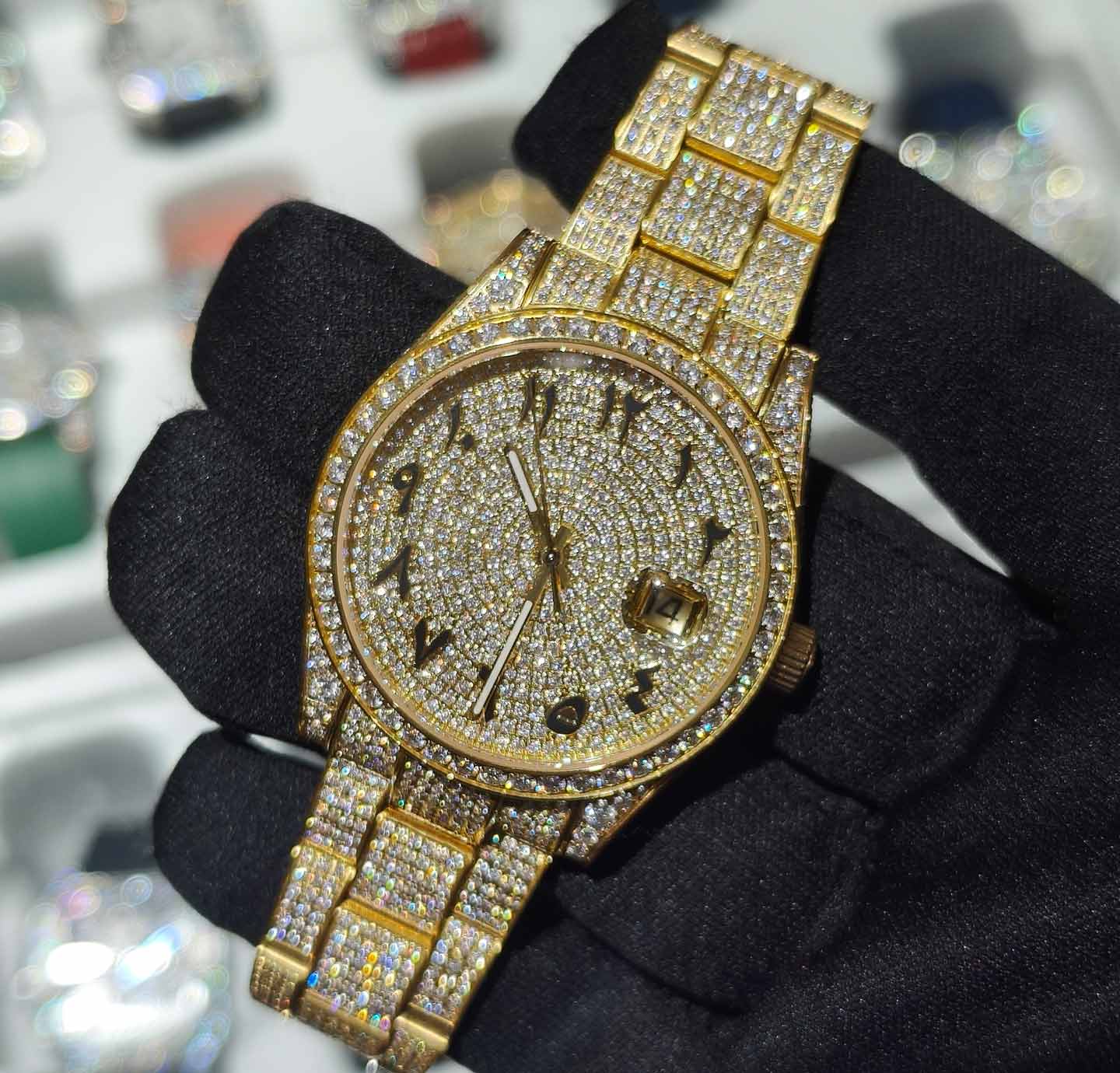
If you adore the "starry sky" effect of dials covered in tiny, glittering stones, pave setting is the technique for you. It involves drilling small holes in the metal dial, inserting small moissanite stones, and then pressing the surrounding metal to form tiny "nails" that secure the stones. This creates a seamless, sparkling surface of closely arranged moissanites.
As professional manufacturers, our pave setting offers two core advantages. First, "dense but not crowded" placement: we calculate hole spacing precisely based on the moissanite's diameter (usually 1-2mm) with a tolerance of no more than 0.02mm, ensuring even pressure distribution and preventing stone friction. Second, "brilliance stacking": small moissanites' sparkle overlaps, creating a "twinkling star" effect under light—more layered than a single large stone.
Pave setting is commonly used on watch bezels and dial marker edges. Our "Starry Sky Collection" features full-bezel pave setting paired with a minimalist dial, suitable for daily wear and elegant enough for dates or parties. However, this technique requires highly skilled craftsmen—each experienced pave setter can only complete 2-3 dials per day.
4. Channel Setting: The Modern "Floating Aesthetics"
Channel setting, or "tension setting," uses the tension of metal grooves to clamp moissanite stones in place. No visible prongs or frames are needed, creating the illusion that the moissanite "floats" on the dial. This is the mainstream technique for minimalist moissanite watches in recent years.
The essence of channel setting is "tension control." The groove tension must be perfect—too much risks cracking the moissanite, while too little fails to secure it. We use CNC equipment to calculate groove width and depth precisely, setting the tension between 5-8N based on moissanite's hardness. This ensures security without damage. We also perform "seamless polishing" on groove edges, blending metal and moissanite seamlessly to enhance the floating effect.
Channel setting pairs perfectly with minimalist moissanite watches. Our "Minimalist Style Collection" features a single center stone in channel setting with an unadorned dial, highlighting the moissanite's brilliance. It's深受 consumers pursuing "understated luxury" love. However, channel setting works best with round moissanites (3-5mm in diameter); smaller stones are difficult to secure with grooves.
5. Column Setting: The Vintage "Three-Dimensional Sparkle"
Column setting is a more traditional technique that uses two parallel metal columns to hold moissanite in place. Gaps between the columns allow light to enter from multiple angles, creating three-dimensional sparkle. This technique exudes vintage elegance and is often used in high-end retro moissanite watch collections.
We've innovated traditional column setting in two key ways. First, we replaced the classic round columns with diamond-shaped ones, increasing contact area with the moissanite for better stability while reflecting light through diamond facets to complement the moissanite's sparkle. Second, we plate the columns with rose gold or platinum to enhance vintage texture and collectibility.
Column setting is ideal for baguette or oval moissanites. Our "Vintage Lady Collection" features oval moissanites in column setting paired with leather straps, recreating 1950s luxury—perfect for vintage style enthusiasts.
How Inlay Techniques Impact Moissanite Watch Selection: 3 Core Tips
After learning about different inlay techniques, many consumers wonder how to choose based on their needs. Drawing on over a decade of user feedback, we offer three practical suggestions:
1. Choose by Wearing Scenario
For frequent daily wear (commuting, sports), prioritize bezel setting or prong setting for better security. For formal occasions (banquets, weddings), opt for pave setting (starry effect) or channel setting (understated luxury). For vintage style lovers, column setting is ideal.
2. Choose by Moissanite Size
Large center stones (≥5mm diameter) pair best with 6-prong setting to maximize brilliance and security. Medium stones (3-5mm) suit channel setting or 4-prong setting (balancing beauty and security). Small stones (≤3mm) work well with pave setting for dense sparkle.
3. Choose by Budget
Craft complexity directly affects cost: Pave setting (high labor cost) > Column setting > Prong setting > Channel setting > Bezel setting. For a premium budget, select pave or column setting in high-end collections. For value for money, choose bezel or prong setting in basic collections—without compromising quality.
Maintenance Tips for Moissanite Watch Inlays (Exclusive from Professional Manufacturer)
Proper maintenance extends a moissanite watch's lifespan, regardless of the inlay technique. Sharing three key tips from our production experience:
- Avoid severe impacts: Even the most secure bezel setting can loosen if dropped or hit hard—protect against high-impact accidents.
- Clean regularly: Inlays trap dust and oil easily. Clean weekly with a soft brush dipped in warm water, then dry with a suede cloth. Avoid chemical cleaners.
- Inspect periodically: Bring the watch to our after-sales service every 6-12 months for professional checks. Technicians will adjust prong or groove tension if needed.
Craft as the Bone, Sparkle as the Soul
A high-quality moissanite watch is the perfect fusion of moissanite's natural brilliance and artisanal craftsmanship. From classic prong setting to vintage column setting, each technique has unique charm to suit different styles and needs. As professional moissanite watch manufacturers, we adhere to the principle of "craft ensures quality, design showcases taste." Every watch undergoes strict quality control (including 100,000 wear tests and 50 impact tests) to ensure long-lasting sparkle.
If you're unsure which inlay technique suits you, leave a comment with your needs (wearing scenario, budget, style), and our professional consultants will provide personalized advice!
#moissanitewatchmanufacturer #moissantewatch #diamondwatch #luxurymoissanitewatches




 Address: Room 405, Building A, Qianhai Zhichuang Technology Industrial Park, No.60 Nanchang Road, Nanchang Community, Xixiang Street, Baoan District, Shenzhen, China